


close
Choose Your Site
Global
Social Media


Views: 222 Author: Rebecca Publish Time: 2026-01-05 Origin: Site


Content Menu
● Understanding Plastic Material Cost Components
>> 2. Masterbatch and Additives
>> 4. Regrind and Waste Factor
● Step-by-Step Method: How To Calculate Plastic Material Cost
>> Step 1: Identify Key Inputs
>> Step 2: Apply the Cost Formula
>> Step 3: Include Production Losses
>> Step 4: Consider Masterbatch Efficiency
>> Step 5: Calculate the Cost per Product
● Factors Influencing Masterbatch Cost
● Optimizing Plastic Material Cost
>> a. Choose Economical Masterbatch Grades
>> b. Balance Recycled and Virgin Material
>> d. Evaluate Processing Conditions
>> e. Collaborate with Material Suppliers
● Importance of Accurate Material Cost Calculation
● Common Mistakes in Cost Calculation
● FAQ on Plastic Material Cost Calculation
>> 2. How much Masterbatch should I use?
>> 3. What's the difference between Filler Masterbatch and Color Masterbatch?
>> 4. Can recycled plastics be used with Masterbatch?
>> 5. How can I reduce Masterbatch cost without losing quality?
In today's competitive manufacturing landscape, knowing how to calculate plastic material cost is crucial for optimizing profitability and maintaining consistent production quality. For manufacturers, distributors, and product designers, understanding cost structure goes beyond raw resin price—factors such as Masterbatch, additives, processing efficiency, and waste rate all play key roles.
This article provides a step-by-step guide to help you determine plastic material costs accurately, taking into account variables like Masterbatch concentration, resin types, and production efficiency.

Before diving into calculations, it's essential to identify the primary elements that influence your total material cost. Plastic material cost generally depends on the type of resin, filler, Masterbatch, colorant, and any reinforcement materials used.
The base resin, such as PP, PE, ABS, or PC, forms the largest portion of the material cost. Resin prices fluctuate with market conditions, oil prices, and supplier terms. Always check the resin's price per kilogram (kg) as the foundation for cost estimation.
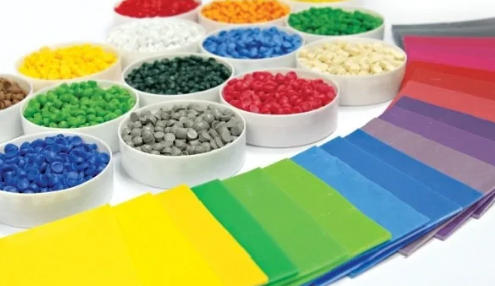
Masterbatch is a concentrated mixture of pigments, fillers, or functional additives encapsulated in a carrier resin. It enhances product functionality and appearance without affecting the base polymer's mechanical properties. The Masterbatch loading ratio (e.g., 2%–5%) directly influences total cost.
Every resin behaves differently during extrusion, injection molding, or blow molding. A polymer's MFI (Melt Flow Index), thermal stability, and moisture content affect production efficiency, material usage, and scrap rate—all contributing to real cost.
Recycled materials (regrind) or scrap can reduce or increase cost depending on the quality. A high regrind ratio decreases virgin material usage but might impact performance. The waste rate (commonly 2–5%) must be accounted for in your cost calculation.
Here's a practical and structured way to calculate plastic material cost per kilogram or per part.
Gather the following information:
- Base resin price (C₁): USD/kg
- Masterbatch price (C₂): USD/kg
- Masterbatch ratio (R₁): %
- Additive or filler cost (C₃): USD/kg
- Additive ratio (R₂): %
- Waste rate (W): %
The approximate plastic material cost per kg is given by:
Material Cost=(C1×(1−R1−R2))+(C2×R1)+(C3×R2)
Then adjust for waste:
Final Cost per kg=Material Cost÷(1−W)
Always include material losses from start-up, color changes, and contamination. These indirect costs can add 1–2% to total material cost, depending on process stability.
If the Masterbatch is high in concentration, you might achieve the same color intensity with a lower percentage, which saves costs. Comparing Masterbatch performance and cost is key to optimization.
Finally, multiply your final cost per kilogram by the weight of each product (in kg):
Cost per Part=Final Cost per kg×Part Weight (kg)
This gives an accurate cost per finished item before adding labor, energy, and overhead.
Let's consider a practical example for a manufacturer using PP resin with color Masterbatch and UV additive:
- Base resin (PP): USD 1.20/kg
- Masterbatch: USD 3.00/kg
- Additive: USD 2.50/kg
- Masterbatch ratio: 3% (0.03)
- Additive ratio: 1% (0.01)
- Waste rate: 4% (0.04)
Step 1:
Material Cost=(1.20×(1−0.03−0.01))+(3.00×0.03)+(2.50×0.01)=(1.20×0.96)+0.09+0.025=1.278=(1.20×0.96)+0.09+0.025=1.278
Final Cost per kg=1.278÷(1−0.04)=1.331
Thus, your final plastic material cost is approximately USD 1.33/kg.
If each product weighs 0.15 kg:
0.15×1.33=0.20
The pigment loading in Masterbatch determines its performance and cost. Higher pigment levels provide stronger color performance but at higher prices.
The carrier resin (e.g., PE, PP, PET) must match the base polymer to ensure proper dispersion. While compatibility enhances product quality, it may slightly increase cost.
Functional Masterbatch, such as UV stabilizers, flame retardants, and anti-static types, provide value-added benefits but also increase price per kilogram.
Large production orders typically lower Masterbatch cost per unit due to economies of scale. Custom colors or special grades often require setup fees or minimum batch orders (MOQ).
To remain cost-competitive, manufacturers need strategies to improve material utilization without sacrificing product quality.
Selecting a high-performance Masterbatch with better dispersion can reduce consumption by 20–30%, resulting in lower total cost.
Combine quality regrind and virgin polymer to achieve a cost-effective blend. However, continuous testing is needed to ensure product consistency.
Filler Masterbatch (with calcium carbonate or talc) can reduce cost per kilogram significantly. It not only lowers resin consumption but also improves stiffness and heat resistance in certain applications.
Optimize machine parameters like temperature, screw speed, and pressure. Better settings minimize degradation, color variation, and waste, improving efficiency.
Work closely with Masterbatch and resin producers for customized solutions. Tailored formulations often lead to lower cost and enhanced performance per application.
Accurate material costing improves:
- Quotation accuracy for customer projects
- Budget forecasting for production runs
- Profit margin control across product lines
- Supply chain efficiency by anticipating material needs
For export-oriented manufacturers, especially in China, transparent and precise cost calculation enhances competitiveness in global markets.
- Ignoring Masterbatch concentration differences between suppliers.
- Underestimating waste and rework percentage.
- Failing to consider exchange rate and freight costs for imported materials.
- Overlooking the effect of filler Masterbatch on product density and performance.
- Using inconsistent measurement units or rounding errors in cost formulas.
Calculating plastic material cost accurately is more than just adding up resin and Masterbatch prices. It requires a clear understanding of resin performance, Masterbatch efficiency, filler ratios, and waste factors. By combining data-driven calculations with supplier insights, manufacturers can achieve optimized material selection and sustainable cost savings.
When done correctly, accurate cost analysis helps you maintain profitability, consistency, and quality—three pillars of success in modern plastics manufacturing.

A Masterbatch is a highly concentrated pigment or additive mixture used to color or enhance plastics. It ensures uniform dispersion and reduces formulation complexity during production.
The loading rate typically ranges from 1% to 5%, depending on color strength and carrier compatibility. Too much can affect mechanical properties or increase cost unnecessarily.
Color Masterbatch focuses on providing pigmentation, while Filler Masterbatch contains materials like calcium carbonate to reduce cost and modify physical properties.
Yes, Masterbatch is compatible with most recycled plastics, though dispersion and color consistency must be checked. Specialized grades are available for recycled resins.
Collaborate with trusted suppliers to develop high-efficiency Masterbatch, optimize dosing accuracy, and use filler Masterbatch strategically for cost reduction.


