


close
Choose Your Site
Global
Social Media


Views: 222 Author: Rebecca Publish Time: 2026-01-04 Origin: Site


Content Menu
● Understanding PP Masterbatch
● The Science of Compatibility
● PP Masterbatch and Polyethylene (PE)
● PP Masterbatch and Polystyrene (PS)
● PP Masterbatch and Biodegradable Polymers
● Impact of Processing Parameters on Compatibility
● Industrial Applications of PP Masterbatch
● The Future of PP Masterbatch Compatibility
● FAQs About PP Masterbatch Compatibility
>> 1. What determines the compatibility of PP Masterbatch with other polymers?
>> 2. Can PP Masterbatch be used with polyethylene?
>> 3. Why is PP Masterbatch incompatible with polystyrene?
>> 4. How can compatibility be improved when using PP Masterbatch with other materials?
>> 5. What is the most promising innovation in Masterbatch compatibility?
Polypropylene (PP) is one of the most versatile thermoplastics in the global polymer market, widely used in automotive components, packaging, household goods, and industrial applications. Its adaptability comes not only from its intrinsic properties but also from the vast range of modification possibilities through additives — particularly Masterbatch. The PP Masterbatch plays a crucial role in enhancing the performance, appearance, and processing characteristics of polypropylene products. However, ensuring compatibility between PP Masterbatch and other materials remains a key challenge for material scientists, manufacturers, and processors alike.
This article delves into the complex relationship between PP Masterbatch and various materials, exploring how compatibility influences product quality, process efficiency, and long-term stability.
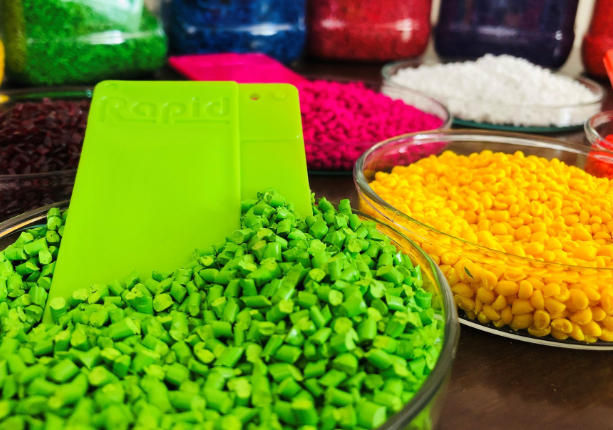
Masterbatch refers to a concentrated mixture of pigments, additives, or both, encapsulated in a carrier resin. The key function of a PP Masterbatch is to distribute colorants and performance-enhancing agents uniformly within a PP matrix during processing. It acts as an efficient and economical way to introduce additives such as:
- Colorants (for aesthetic control)
- UV stabilizers (to improve outdoor durability)
- Antioxidants (to enhance thermal resistance)
- Fillers (for strength and rigidity)
- Flame retardants (for safety compliance)
Typically, PP Masterbatch uses polypropylene as its carrier resin, ensuring good dispersion and chemical compatibility. Yet, when PP Masterbatch needs to interact with non-PP materials — like polyethylene (PE), polystyrene (PS), acrylonitrile butadiene styrene (ABS), or even biodegradable polymers — understanding its compatibility becomes essential.
Compatibility in polymer systems depends on molecular interactions and the physical miscibility between materials. If the carrier resin of a Masterbatch differs significantly from the base polymer, poor interfacial adhesion can occur, leading to visual defects, mechanical weaknesses, and uneven additive dispersion.
In practice, manufacturers may face:
- Color streaking or unevenness from incompatible pigment dispersion.
- Phase separation between different polymer matrices.
- Reduced mechanical strength due to poor bonding.
- Processing difficulties, like die buildup or uneven melting.
To avoid these issues, PP Masterbatch formulations must be engineered for thermodynamic and morphological compatibility with the target material.
Polypropylene and polyethylene are both polyolefins, meaning they share similar chemical structures. This chemical similarity enables relatively good compatibility, especially between PP Masterbatch and high-density polyethylene (HDPE) or linear low-density polyethylene (LLDPE). Blending PP with PE is a common industrial practice to modify stiffness, transparency, and impact resistance.
However, even among polyolefins, differences in crystallinity and melt viscosity can lead to partial phase separation. In such cases:
- Compatibilizers like polyethylene-grafted maleic anhydride (PE-g-MA) can enhance bonding.
- Adjusting processing temperatures near the mid-range of both polymers' melting points helps achieve better mixing.
- Using a dual-carrier Masterbatch (both PP and PE in its formulation) ensures smoother dispersion in co-polymer systems.
The compatibility between PP Masterbatch and polystyrene is, by contrast, far less favorable. PP is non-polar and semi-crystalline, while PS is an amorphous, polar polymer. These chemical and physical disparities create distinct boundaries that inhibit additive migration and dispersion.
Manufacturers attempting to color PS products with PP-based Masterbatch often encounter:
- Uneven color dispersion.
- Brittle interfaces leading to cracking.
- Cloudiness or delamination during extrusion.
In such cases, it's more effective to develop PS-compatible Masterbatch formulations using polystyrene as the carrier resin. Alternatively, universal Masterbatches can be used, formulated on carrier systems that balance between multiple polymer matrices, though this usually compromises performance for convenience.
Acrylonitrile Butadiene Styrene (ABS) presents an even more complex challenge for PP Masterbatch. ABS contains both polar and non-polar components, leading to very poor interfacial adhesion with polypropylene. A PP Masterbatch introduced into ABS can disrupt the polymer matrix, leading to voids, poor surface finish, and significant mechanical property loss.
To ensure compatibility:
- Use ABS-based Masterbatch instead of PP-based.
- Introduce compatibilizers or coupling agents like maleic anhydride-grafted PP (PP-g-MA) to improve bonding at the interface.
- Consider surface modification or plasma treatment on the Masterbatch to enhance interaction with ABS components.
In short, while chemical ingenuity can create short-term compatibility, long-term stability remains elusive when PP Masterbatch interacts with high-polarity polymers like ABS.
As sustainability becomes a global manufacturing priority, the interaction between PP Masterbatch and biodegradable materials (like PLA, PBAT, or PHA) draws increasing research interest. However, most biodegradable polymers are esters or polyesters with high polarity, drastically different from the non-polar structure of polypropylene.
The result is typically poor interfacial adhesion, pigment separation, and unstable additive migration. Possible approaches include:
- Developing biodegradable Masterbatch variants using bio-based carrier resins compatible with PLA or PBAT.
- Blending technology, where small amounts of PP Masterbatch are physically incorporated via a compatibilizing agent.
- Reactive extrusion, allowing chemical grafting between PP and biodegradable phases.
While the market for PP Masterbatch with biodegradable materials remains experimental, innovation in coupling agents and nanocomposite Masterbatch technology shows promise.
Even with optimized chemical composition, processing conditions determine the final compatibility outcome. Factors such as melt temperature, shear rate, mixing time, and cooling speed can influence dispersion and bonding at a microscopic level.
For example:
- High shear mixing during extrusion improves pigment dispersion.
- Controlled cooling helps uniform crystallization of PP phases.
- Proper drying of hygroscopic additives prevents void formation.
- Optimized screw design in injection molding ensures even distribution of Masterbatch across the polymer melt.
Adjusting these parameters can often improve compatibility outcomes without altering the Masterbatch formulation itself.
To scientifically assess whether a PP Masterbatch is compatible with a particular polymer system, manufacturers employ a range of analytical techniques:
- Differential Scanning Calorimetry (DSC) – to observe melting and crystallization behavior.
- Scanning Electron Microscopy (SEM) – to detect phase separation and surface morphology.
- Spectroscopic analysis (FTIR) – to track chemical bonding and additive migration.
- Mechanical testing – to analyze tensile strength and impact performance after compounding.
Quantitative and visual data from these tests inform engineers on whether modifications are needed for color uniformity, strength, or processing efficiency.
The PP Masterbatch serves industries far beyond simple coloration. Its compatibility profile allows for precision engineering in:
- Automotive interiors and components – requiring UV stabilization and aesthetic consistency.
- Packaging films – where clarity, anti-block, and slip properties must align perfectly.
- Fiber and textile production – using additive Masterbatch to ensure heat stabilization and anti-static properties.
- Home appliances – demanding flame retardance and long-term durability.
- Construction materials – enhancing weather resistance and structural uniformity.
Each of these sectors depends heavily on understanding polymer compatibility to maintain consistent product performance.
As new materials and regulations shape global manufacturing, the future of PP Masterbatch compatibility lies in smart design. Researchers are focusing on multi-phase carrier systems that combine PP with functional copolymers, allowing broader compatibility without compromising performance. Furthermore, nanotechnology-based Masterbatch formulations promise enhanced dispersion at molecular scales, bridging gaps between dissimilar materials.
Digital simulation tools — such as molecular dynamics modeling — are helping predict compatibility before pilot production, saving both cost and time. Ultimately, the future points toward sustainability, process efficiency, and universal adaptability.
The compatibility of PP Masterbatch with other materials defines not only product quality but also the cost-effectiveness and environmental sustainability of manufacturing operations. While polypropylene's affinity for polyolefins like PE ensures wide usability, challenges persist with polar polymers and biodegradable substitutes. Through chemical modification, compatibilizer design, and precise processing control, manufacturers can optimize compatibility and unlock the full potential of PP-based Masterbatch systems.
In a rapidly evolving materials landscape, understanding and engineering compatibility remains the key to innovation.

The primary factors include the chemical similarity between the carrier resin and base polymer, molecular polarity, and processing temperatures. When these are aligned, dispersion and bonding are significantly improved.
Yes, PP and PE are relatively compatible due to their shared polyolefin foundation. However, adjustments in processing and the use of dual-carrier Masterbatches can further enhance results.
PP is non-polar and crystalline, whereas PS is polar and amorphous. Their structural differences prevent effective intermixing, leading to poor dispersion and weak mechanical performance.
Manufacturers use compatibilizers, like grafted copolymers, or modify processing conditions such as melt temperature, shear rate, and mixing time to achieve better material integration.
Nanocomposite and hybrid-carrier Masterbatch technologies are at the forefront, offering improved pigment dispersion, interfacial bonding, and broader cross-material applicability.


